By Pete Jackson
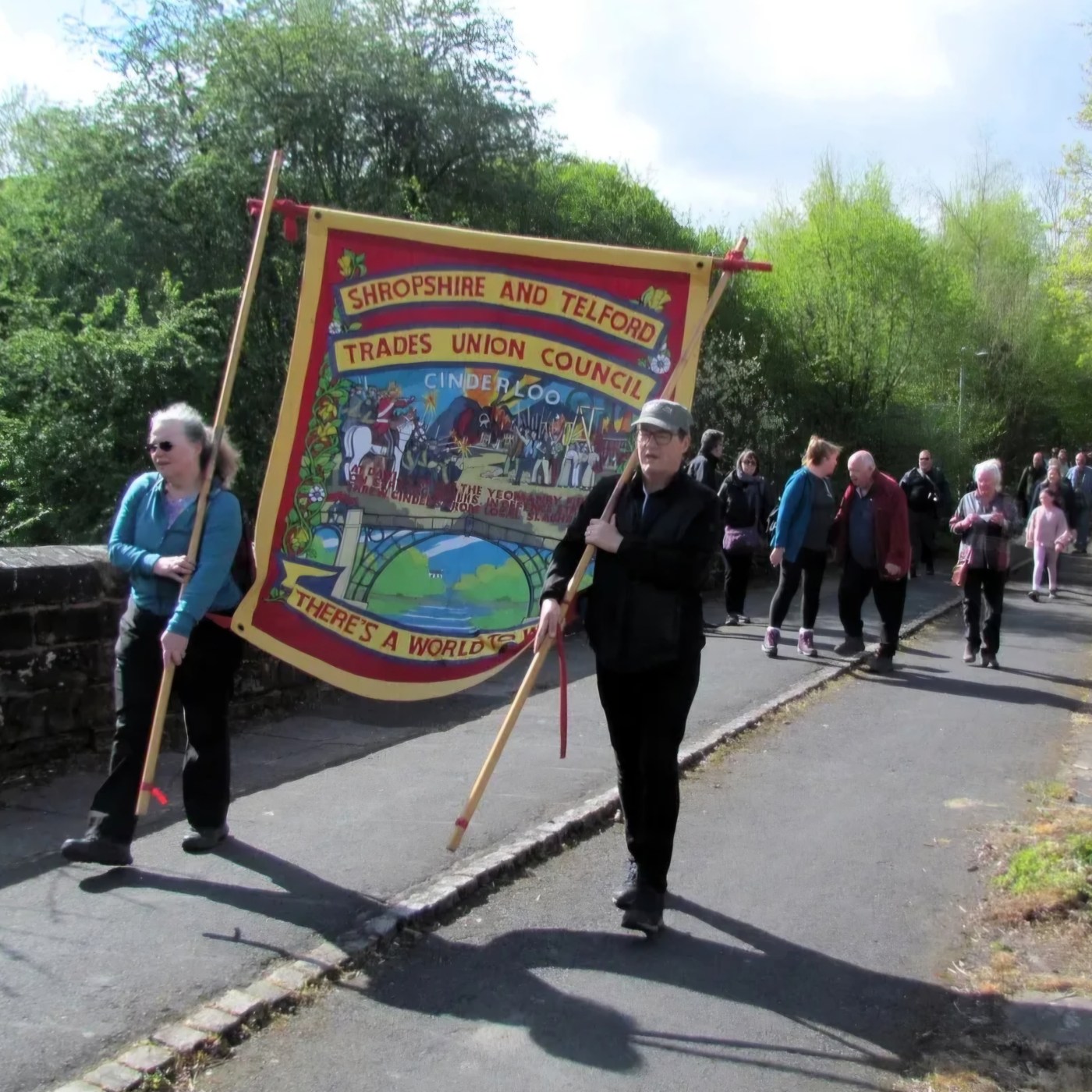
In the corner of a room in Blists Hill Victorian Museum, Telford, bold colours and embroidered conviction hang quietly on a wall. But the Shropshire and Telford Trades Union Council banner, with its vivid depictions of the 1821 Cinderloo Uprising, is anything but silent.
Recently, I spoke with Mike Edwards from the Trades Council, who shared the background to the banner’s creation—how it came to be commissioned, who shaped its design, and why it remains such a powerful symbol of working-class resistance.
In the early 2000s, at a time when the story of the Cinderloo Uprising was still relatively unknown outside local memory, the Trades Council took the bold step of commissioning a new banner. They turned to Ed Hall, Britain’s most respected banner maker, renowned for reviving the craft and infusing it with political purpose. Hall, whose works have featured in protests, galleries, and collaborations with artist Jeremy Deller, travelled to Telford to gain a sense of place and story. His visit coincided with the recent publication of Ian Thomas’s dissertation—the first academic study of the Cinderloo events—and the trade union council recognised the importance of anchoring the banner in this rediscovered history.
Hall’s design draws deeply from the iconography of classic trade union banners, a tradition documented by John Gorman in his influential book Banner Bright (1973). As Gorman describes, these banners are “embroidered acts of defiance,” blending art, memory, and message. The Cinderloo banner fits this tradition while speaking boldly in its own voice.
At the base is a powerful quote: “WE HAVE A WORLD TO WIN.” Borrowed from the rhetoric of revolutionary movements, this slogan is both historical and prophetic. It links the colliers of 1821 with contemporary campaigns for justice, equality, and workers’ rights. Beneath it, in vibrant colour, is a detailed and dynamic scene of the uprising: mounted Yeomanry confront a mass of strikers and their wives at Old Park; smoke rises from the furnaces; a banner is raised high amid the chaos.
Surrounding the central image is a floral wreath, a traditional motif in banner-making that symbolises mourning, honour, and unity. In the Cinderloo banner, the wreath is more than decoration—it echoes the lives lost at the protest, especially those of Thomas Gittens, William Bird, and Thomas Palin, and honours their memory alongside the everyday courage of unnamed protestors. The flowers evoke solidarity across the nations of Britain, while also referencing the aesthetic of earlier union banners that blended idealism with remembrance.
At the foot of the banner is a striking image of the Iron Bridge, a proud local emblem of industrial ingenuity. But here, it becomes more than an architectural feat—it symbolises the connection between industrial labour and the struggle for dignity. The bridge is anchored by the banner’s defining message: “WE HAVE A WORLD TO WIN.” A reminder that Cinderloo’s legacy lives not just in the past but in every step forward for collective justice.
The banner also draws on older traditions of public display. As Mike noted, in Dawley and across Telford, the annual church and chapel “demonstrations” were once a staple of community life. Parishioners would march behind chapel banners—accompanied by brass bands—in acts of public pride, spiritual solidarity, and collective identity. These processions, sometimes called “walking days,” brought entire communities onto the streets in joyful assertion of their values. Professor Roy Jones, who grew up in Dawley before emigrating to Australia and becoming a respected academic in cultural geography, recalls proudly taking part in these marches as a child. Decades later, on returning to his home town, he reverently joined the Cinderloo walk, once again marching behind a banner—this time not of his childhood chapel, but of the Shropshire and Telford Trades Council, commemorating the colliers who stood for justice in 1821. In doing so, he bridged the symbolic past and present, a living witness to the continuity of collective identity, place, and protest.
This living tradition of banner protest is also reflected in the story of the NUM Granville Colliery banner. When Granville—Telford’s last deep mine—closed in 1979, the banner was carried one last time in a symbolic act of pride and farewell. Today, that banner is on display at Blists Hill Museum, a quiet yet powerful reminder of the region’s industrial and trade union heritage (Telford Journal, July 1, 2004). In contrast, the Cinderloo banner remains active—regularly marched and displayed as a living, travelling symbol of solidarity and memory. Together, they represent not only remembrance but resilience—the enduring link between labour, place, and protest.
Since its unveiling in 2004, the Cinderloo banner has travelled widely. It has appeared at May Day rallies, anti-austerity protests, NHS solidarity events, Palestinian solidarity marches, and educational walks. For those who carry it, the banner is not just a symbol of remembrance but a call to action. It affirms that the fight for justice didn’t end in 1821—and it won’t end now.
As Mike Edwards put it: “This banner wasn’t made to hang quietly in a museum. It was made to be carried, to speak truth to power, to show up in the streets. It honours our past, yes—but more than that, it urges us forward. It reminds us that we still have a world to win.”
 Cinderloo 1821 Remembered
A powerful reminder
LikeLike